


Average Cost of Water Heater Replacement in 2026

Table of Contents
What the Average Cost of Water Heater Replacement Actually Covers
Water Heater Installation Cost: Breaking Down the Line Items
Equipment and Materials
Labor, Removal, and Disposal
Tank vs. Tankless and Fuel Type: How the Replacement Unit Changes the Price
Like-for-like replacement: the baseline
Tank-to-tankless conversion: where the price jumps
Fuel switches: gas to electric, electric to heat pump
How the options compare on the factors that move price
The long-run trade-off
50-Gallon Gas Water Heater Replacement Cost: The Most Common Upgrade
Water Heater Repair vs. Replacement: When the Math Flips
Factors That Push the Final Price Up or Down
Installation complexity and site conditions
Removal, disposal, and the line items quotes often bury
Regional price differences and how to read them
How to use these factors when comparing bids
Water Heater Installation Quote Checklist: How to Compare Estimates Line by Line
Frequently Asked Questions
Last Updated: October 19, 2026
What the Average Cost of Water Heater Replacement Actually Covers
The average cost of water heater replacement is not a single number you can pull off a national chart. At Water Heaters Plus!, we publish installation pricing directly on our website.
A water heater replacement is the full removal of an existing unit and installation of a new one, including the tank, connections, venting, and safe disposal of the old equipment.
Most guides quote a national average and stop. Below, we break down every line item so you can read a contractor's estimate and know what you are actually paying for.
Water Heater Installation Cost: Breaking Down the Line Items
Water heater installation cost splits into two buckets: equipment and materials, then labor, removal, and disposal. Skip either one and your comparison falls apart.
Equipment and Materials
The replacement unit is the biggest single line. A traditional storage tank in the most common residential size sits at the lower end of the equipment range, while high-efficiency tankless and hybrid heat pump models climb sharply.
Ask for the exact model number on the quote. A quote that lists only "50-gallon gas water heater" hides whether you are getting a builder-grade unit or a professional model with an extended warranty.
Labor, Removal, and Disposal
Labor covers draining the old tank, disconnecting gas or electrical, hauling it out, and connecting the new one. Removal and disposal is real work: old tanks are heavy, full of sediment, and often wedged into tight utility closets.
A straightforward swap in an accessible basement takes far less labor than one requiring new venting or a relocated gas line. The quote should separate these so you can see where the hours go.
Watch Out A quote that lumps equipment, labor, and disposal into one "installed price" with no breakdown is nearly impossible to compare against another bid. Ask for the itemized version before you sign.
Tank vs. Tankless and Fuel Type: How the Replacement Unit Changes the Price
Tank versus tankless is the biggest price driver after size, and fuel type is second. "Tankless costs more upfront" is true but useless when staring at two bids. What actually moves the number is the upgrade work each option forces, venting, gas sizing, electrical capacity, and space, and whether your existing utility setup can absorb the new unit without modification.
Like-for-like replacement: the baseline
A like-for-like swap keeps the same fuel, size, venting, and location, the cheapest realistic scenario, because the contractor is not opening walls, resizing gas lines, or pulling new circuits. In most markets, a standard 40- to 50-gallon gas tank swap with existing venting in an accessible location is the low end of the installed range, and an electric tank swap with an existing 240-volt circuit is comparable or slightly lower on labor.
Tank-to-tankless conversion: where the price jumps
A tankless conversion is rarely a swap. It is a small remodeling job. The common upgrade line items are:
Venting. Tankless gas units typically require stainless steel Category III venting, not the galvanized B-vent a tank uses. That means new vent runs, new penetrations, and sometimes a different termination location.
Gas line sizing. Tankless units fire at much higher BTU input than a tank. A 1/2-inch line that fed a 40,000 BTU tank often cannot supply a 180,000-199,000 BTU tankless unit. Upsizing the gas line is a common added cost.
Electrical. Most gas tankless units need a 120-volt circuit for controls and the condensate pump on condensing models. If no outlet is near the unit, that is new wiring.
Fuel switches: gas to electric, electric to heat pump
Switching fuel type is a bigger project than switching tank style. A gas-to-electric switch requires a dedicated 240-volt circuit sized for the element load, possibly a panel upgrade. An electric-to-gas switch requires a gas service, meter, and venting, often the most expensive path because it may involve the utility. A heat pump hybrid adds its own requirements: clearance for air intake and exhaust, a condensate drain, and a location above roughly 40°F.
How the options compare on the factors that move price
Option | Relative Upfront Cost | Typical Added Work vs. Like-for-Like | Best For |
Traditional tank (gas) | Lowest | None if venting and gas line are reused | Most homes with existing gas venting |
Traditional tank (electric) | Low | None if a 240-volt circuit exists | Homes without gas service |
Tankless (gas) | Highest | New venting, gas line upsizing, electrical, condensate | Households with high hot water demand and space for upgrades |
Heat pump hybrid | Higher | Condensate drain, clearance, possibly electrical | Efficiency-focused upgrades with a suitable location |
Key Takeaway Ask each contractor to quote the same fuel and tank style, then ask for a second quote showing the upgrade path. The difference between those two numbers is the true cost of converting, not the sticker price of the tankless unit.
The long-run trade-off
Tankless and heat pump hybrids cost more to install but can reduce energy use over the unit's life. Tankless heats water on demand and avoids standby losses; a heat pump hybrid moves heat instead of generating it and can cut water heating energy use substantially versus a standard electric tank. Those savings depend on household hot water use, local energy prices, and proper sizing, an oversized tankless unit or a hybrid in a cold space will not deliver them.
50-Gallon Gas Water Heater Replacement Cost: The Most Common Upgrade
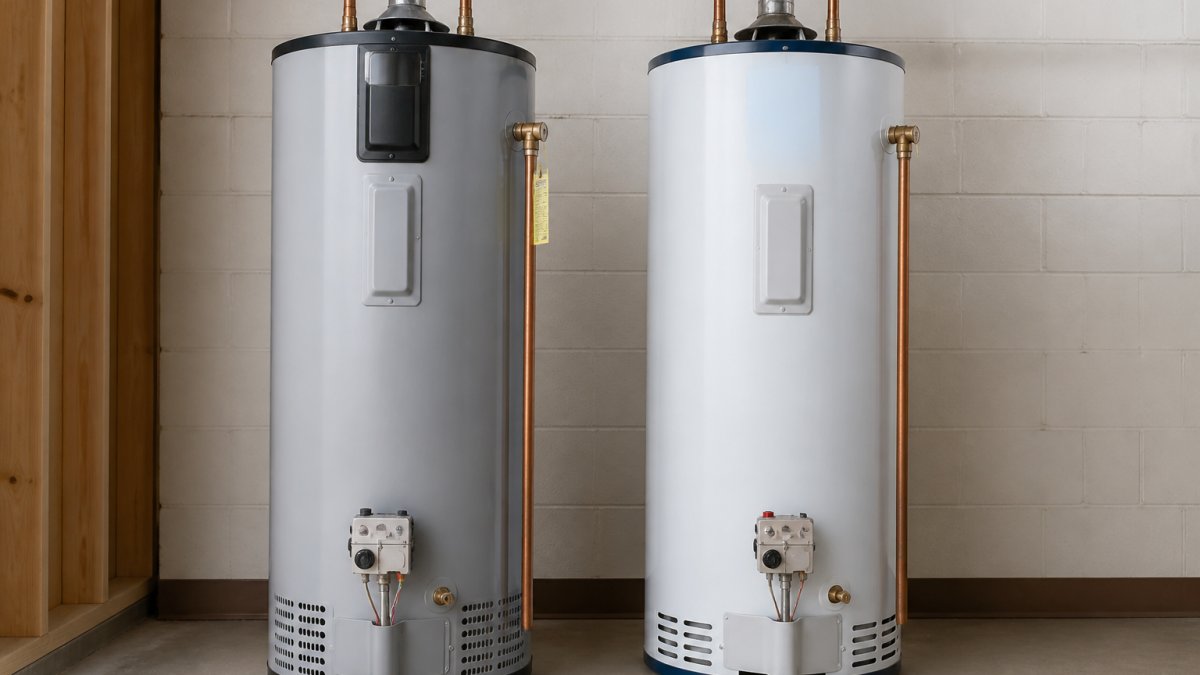
The 50-gallon gas water heater replacement cost is the figure most homeowners want, because a 50-gallon gas tank is the standard size for a family of four.
The price climbs the moment the job stops being like-for-like.
Our advice: if your old 50-gallon gas tank lasted its full lifespan and your household size has not changed, replace it with the same size and fuel.
Water Heater Repair vs. Replacement: When the Math Flips
Repair is right when the unit is young, the fix is cheap, and the problem is isolated.
The math flips on a leaking tank. A tank leak usually means the steel has corroded through, and no repair fixes that. Patching a leaking tank buys weeks, not years.
Age is the other signal. Most storage tanks last roughly a decade, though water quality and maintenance shift that.
Pro Tip Ask the technician one question: "Is this repair on the tank itself or on a part I can replace?" Parts like thermostats, elements, and valves are fixable. A corroded tank is not.
Factors That Push the Final Price Up or Down
Site conditions, code requirements, and regional labor markets drive more price variation than brand or model. Two homeowners with the same 50-gallon gas tank can see bids differ widely because one has a wide-open basement with existing venting and the other a tight second-floor closet with a vent run that no longer meets code. Here is each factor, so you can see which apply to your job.
Installation complexity and site conditions
Access is the most underrated cost driver. A unit in an accessible garage or basement can be drained and hauled out on a hand truck.
Venting condition matters as much as access. A correct, correctly sized, good-condition vent can be reused. If it is undersized, corroded, or the wrong category for the new unit, it must be replaced, a materials-plus-labor line item, not a minor add-on.
Removal, disposal, and the line items quotes often bury
A legitimate quote should show removal and disposal as a line item or explicitly state it is included. The same goes for:
Permits. Many jurisdictions require a permit for water heater replacement, and the fee varies widely by market. A quote that does not mention the permit may be excluding it.
Code upgrades. Current code may require an expansion tank on a closed plumbing system, a drain pan with a drain line, updated venting, or seismic strapping in some areas. These are not optional, and a low bid that omits them is not a comparable bid.
Haul-away and recycling. Some contractors include disposal; others charge separately or leave the old unit on site.
Regional price differences and how to read them
Labor rates, permit fees, and local code requirements differ by market, so a national average is a starting reference, not a bid. Compare like-for-like line items: equipment price, labor hours, permit fee, and code-upgrade items.
Ask each contractor for the same four numbers: equipment model and price, labor hours and rate, permit fee, and a list of code-required upgrades. That gives you a basis to compare bids in your own market and understand why a neighboring market's bid looks different.
How to use these factors when comparing bids
Bring the same scope to every contractor. State the tank size, fuel type, and location, and ask each bid to show equipment, labor, removal and disposal, permit, and code upgrades as separate lines. The U.S. Department of Energy's guidance on water heating is a solid primer on efficiency and equipment types before you compare quotes, and the Federal Trade Commission's guidance on home improvement contracts is worth reading before you sign anything.
Water Heater Installation Quote Checklist: How to Compare Estimates Line by Line

Use this water heater installation quote checklist to compare bids apples to apples. Bring it to every estimate and make each contractor fill in the blanks.
Exact model number and brand of the replacement unit
Tank size in gallons and fuel type
Equipment price listed separately from labor
If two quotes differ by a wide margin, this list tells you why. The Federal Trade Commission's guidance on home improvement contracts is worth reading before you sign anything, and our team at Water Heaters Plus! offers free in-home consultations with written quotes so you can compare the same line items side by side.
Frequently Asked Questions
What is a fair price to replace a water heater?
A fair price is one you can read line by line. Ask for the replacement unit's brand and model number, the gallon capacity, labor hours, permit fees, and removal and disposal of the old tank listed separately. Two quotes for the same model should land close together once those items are itemized. If one estimate is far higher with no extra scope explained, ask the contractor to walk you through the difference before you sign. Get at least three written quotes for the same capacity and fuel type.
Does water heater replacement include removal and disposal of the old unit?
It should, but confirm it in writing. Removal and disposal is a separate line item on many estimates, and hauling away a full tank is real labor. Ask whether the quote covers draining the old unit, disconnecting gas or electrical service, carrying it out, and recycling it. If those items are missing, the final invoice can come in higher than the number you agreed to. A written quote that lists removal and disposal up front is the one to compare against the others.
Is it cheaper to repair or replace a water heater?
It depends on the unit's age and the repair. A single failed element or thermostat on a tank that is a few years old is usually worth fixing. A leaking tank, a cracked heat exchanger, or a repair bill that approaches a large share of a new unit's installed price points toward replacement instead. Also weigh the remaining lifespan: a 12-year-old tank near the end of its service life will likely need replacing soon regardless. Ask the technician for the age, the repair price, and the replacement price side by side.
How can I avoid surprise charges after the technician arrives?
Request a written, itemized quote before work begins and confirm what triggers extra charges. Common add-ons include new venting, gas line resizing, electrical upgrades, permit fees, and code corrections found on site. A reputable contractor will inspect the installation space first and put those possibilities in the estimate rather than discovering them mid-job. Ask directly: what could change this price, and what would each change cost? Get the answer in writing so the invoice matches the quote.
Water heater replacement pricing only makes sense when you can see what each dollar buys. If you are tired of vague estimates and surprise charges, Water Heaters Plus! publishes transparent online installation pricing, stocks trusted brands like AO Smith, Bradford White, and Navien, and sends licensed, insured technicians with over 20 years of experience. Get a quote from Water Heaters Plus! and compare a real, itemized estimate against your next bid.
Get A Quote
Comments