


Commercial Water Heater Maintenance Tips for Facility Managers

Last Updated: October 28, 2026
Quick Summary
Commercial water heater maintenance is a schedule of inspections, flushes, and component checks that keeps hot water running without surprise failures. Match the interval to equipment type and duty cycle: flush gas storage tanks every 6-12 months, and high-demand units every 6 months with twice-yearly inspections. Keep a written service log for every unit, because an interval nobody logs is an interval nobody keeps.
Your staff can handle visual leak checks, thermostat setpoint confirmation, and listening for rumbling during recovery.
Gas connections, burner operation, anode rod inspection, and T&P valve testing belong to a licensed technician.
Flush during your lowest-demand window, open a hot-water tap to break the vacuum, and drain until water runs clear.
Rumbling means sediment, lukewarm water points to a failing element or thermostat, and rust-colored hot water signals a spent anode rod.
Budget three line items: planned maintenance, a repair reserve, and a replacement reserve that accrues toward the expected replacement date.
Table of Contents
Why Commercial Water Heater Maintenance Is a Business Decision
Setting a Commercial Water Heater Service Schedule by Equipment Type
How to Flush a Commercial Water Heater Without Losing a Day of Hot Water
Commercial Water Heater Troubleshooting: What the Symptoms Tell You
Water Quality, Scale Control, and Hard Water in Central Ohio Buildings
Documentation, Codes, and Records That Protect Your Building
Why Commercial Water Heater Maintenance Is a Business Decision
A commercial water heater maintenance tips program is a schedule of inspections, flushes, and component checks that keep a building's hot-water supply running without surprise failures. A failed storage tank does not just cost a repair invoice.
The economics are simple. The U.S. Department of Energy guidance on water heating makes the same point: efficiency losses accumulate long before equipment fails outright.
That is the throughline for everything below.
Building Your Commercial Water Heater Maintenance Checklist
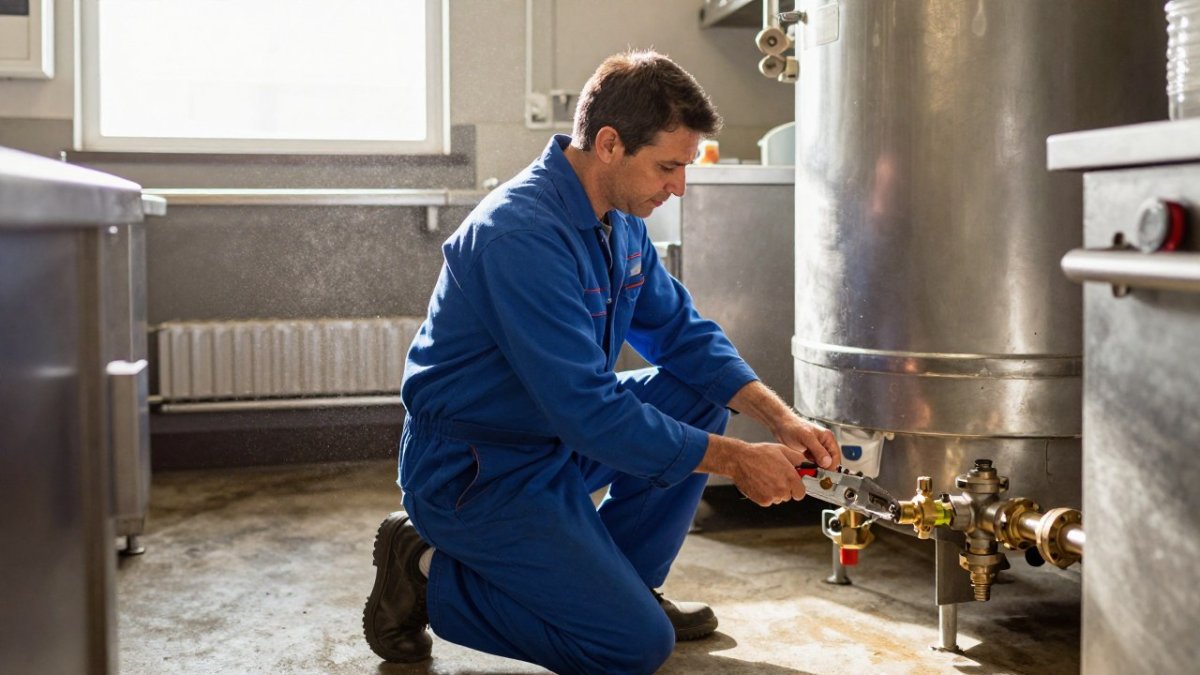
A commercial water heater maintenance checklist separates tasks your staff can handle from tasks that require a licensed technician. Get that line right and you avoid two expensive mistakes: paying a service call for something a maintenance tech could do, and putting an untrained hand on a gas valve or relief valve.
Items You Can Check In-House
Your team can own the observation layer. These checks catch problems early without touching anything pressurized or gas-fired:
Visual scan of the storage tank, fittings, and floor for leaks, rust streaks, or water staining
Confirm the thermostat setpoint matches your intended water temperature
Listen for rumbling, popping, or banging during recovery
Items That Belong to a Licensed Technician
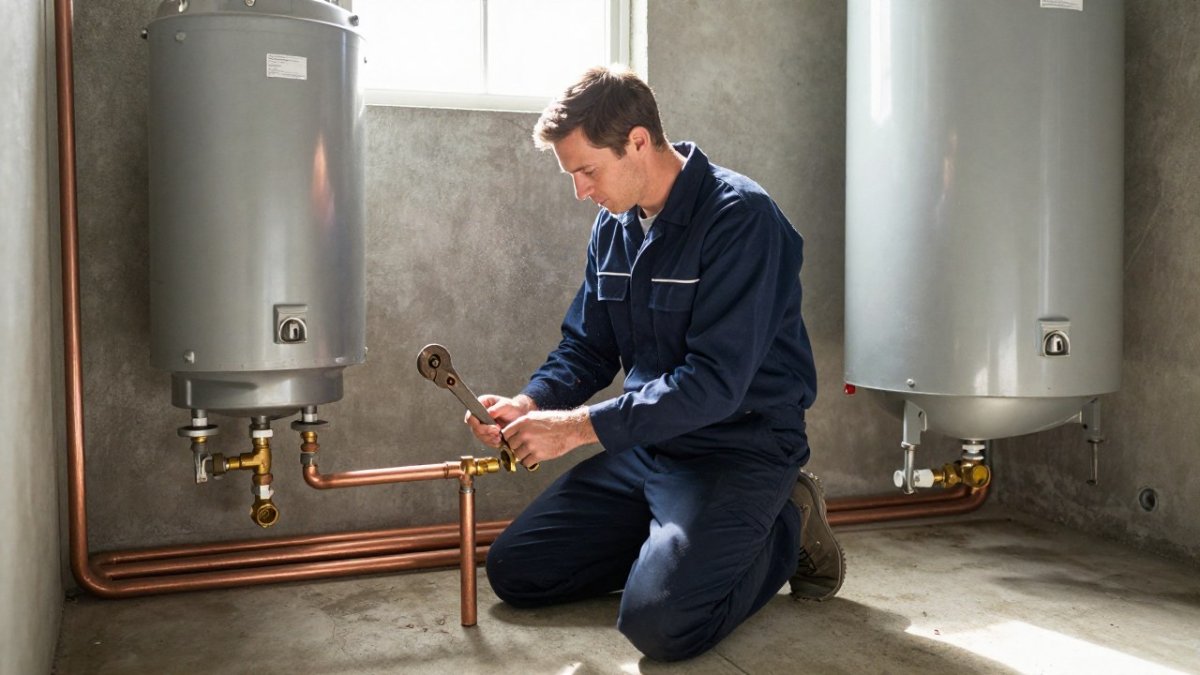
Gas connections, burner operation, combustion testing, electrical connections, anode rod inspection, and T&P valve testing belong to a professional. So does anything involving the shutoff valve or draining a tank you cannot isolate safely.
A common mistake is letting a well-meaning staff member "just test" the temperature and pressure relief valve. When a task crosses that line, it is time to schedule commercial water heater service with a licensed crew rather than improvise.
Setting a Commercial Water Heater Service Schedule by Equipment Type
A commercial water heater service schedule should match the equipment and how hard it works, not a generic annual reminder. The table below is a starting point, not a rule, your manufacturer's instructions and your actual water conditions override it every time.
Equipment Type | Typical Usage | Flush / Descale Interval | Full Inspection | Anode Rod Check |
Gas storage tank | Restaurant, hotel, multi-unit | Every 6-12 months | Annually | Annually |
Tankless | Low-to-moderate demand | Annually with descaling | Annually | Not applicable |
Electric storage | Light commercial, office | Annually | Annually | Annually |
High-demand storage | 24/7 operations | Every 6 months | Twice yearly | Every 6 months |
High-recovery / booster | Commercial kitchen, laundry | Every 6 months | Twice yearly | Annually |
How to Adjust the Interval for Your Building
The pattern is straightforward: the harder the unit works and the harder your water is, the shorter the interval. Three variables should push you toward the shorter end of every range:
Duty cycle. A unit running near continuous recovery (a hotel with steady occupancy, a 24/7 food-service operation) accumulates sediment and thermal stress faster than an office unit that idles overnight. Move high-demand and high-recovery units to a six-month flush and a twice-yearly inspection.
Water hardness and sediment load. Hard water deposits scale on heat-exchange surfaces; well water can add iron and mineral staining. If your log shows sediment at every flush, shorten the interval rather than waiting for the calendar. A tankless heat exchanger is especially sensitive, scale cuts flow and efficiency before anyone notices a temperature complaint.
Operating environment. Mechanical rooms that run hot, dusty, or humid stress electrical components and combustion air quality. Units in tight closets or near grease-laden kitchen air need more frequent burner and vent checks.
Write the Schedule Down and Tie It to Records
What most guides miss is that the schedule has to be written down and tied to service records. An interval nobody logs is an interval nobody keeps. Build a one-page schedule per unit that lists the task, the interval, the last date performed, and the next due date, and keep it with the service log covered later in this guide.
Pro Tip Set the next-due date at the time of service, not from memory. A shared calendar reminder tied to the unit's nameplate or asset tag is the simplest way to keep a multi-unit building on rhythm.
If you are unsure which interval fits your equipment, a licensed technician can assess duty cycle and water conditions and recommend a schedule you can maintain.
How to Flush a Commercial Water Heater Without Losing a Day of Hot Water
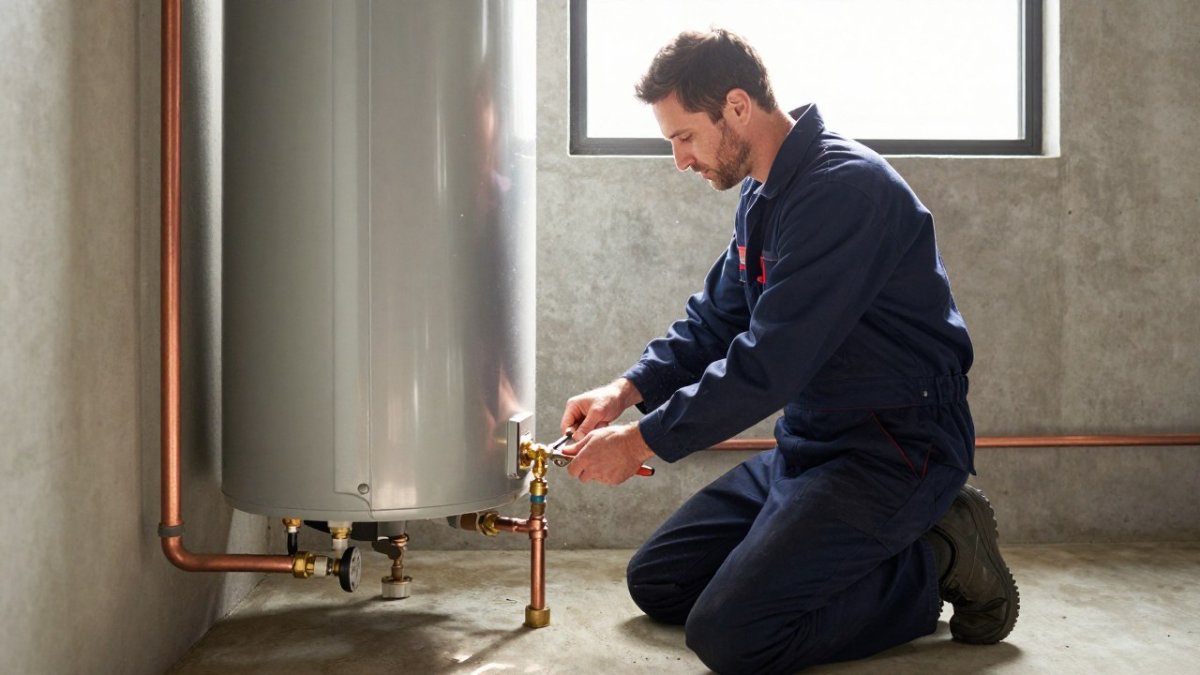
Flushing a commercial water heater means draining the tank through the drain valve to clear sediment, then refilling and restoring temperature. The trick to avoiding downtime is staging the work around your demand curve, not shutting the building down mid-service.

Here is how we would sequence it:
Schedule for your lowest-demand window, typically overnight or between service periods.
Shut off power or gas and close the cold-water shutoff valve.
Connect a hose to the drain valve and route it to a safe drain.
Open a hot-water tap to break the vacuum, then open the drain valve.
Drain until the water runs clear, then close the valve and refill.
Restore power or gas and confirm recovery before the building opens.
Watch out: skipping the vacuum break on step four leaves the tank draining slowly or not at all, and reopening a drain valve on a pressurized tank can spray scalding water. If you cannot isolate the unit cleanly, this is a job for a technician.
For a symptom-first walkthrough of a unit that has already quit, our step-by-step water heater repair guide pairs well with this section.
Commercial Water Heater Troubleshooting: What the Symptoms Tell You
Commercial water heater troubleshooting starts with reading symptoms before touching parts. Rumbling points to sediment. Lukewarm water that never recovers points to a failing heating element, thermostat, or undersized unit.
Leaks at fittings are often a pressure problem wearing on connections.
The practical takeaway is to log the symptom, the time, and the conditions, then hand that record to your service provider. Good records shorten diagnosis and reduce billable time.
Water Quality, Scale Control, and Hard Water in Central Ohio Buildings
Hard water is the quiet driver behind most maintenance you will do.
Scale control is cheaper than scale removal. A water softener or conditioning system keeps minerals from depositing in the first place, which means fewer flushes, less descaling, and steadier performance.
If your maintenance log keeps showing the same sediment or scale complaints, treat that as a water quality signal rather than a plumbing nuisance.
Documentation, Codes, and Records That Protect Your Building
Records are the part everyone skips and the part that pays off.
Codes and manufacturer recommendations matter here too. Commercial installations are governed by plumbing and mechanical codes that specify relief valve requirements, discharge piping, and combustion air.
A simple rule: if it is not written down, it did not happen. Photograph nameplate data and keep it with the log.
Budgeting Maintenance Against Repair and Replacement Costs
The repair-versus-replace decision is a lifecycle calculation, not a gut call. Treat the water heater as a capital asset with a service life, a maintenance cost curve, and a replacement trigger, then budget against those three things instead of reacting to the next breakdown.
Build a Simple Lifecycle Budget
You do not need a spreadsheet model to budget well. Three line items cover most commercial programs:
Planned maintenance. The annual cost of flushes, inspections, anode rod replacement, and descaling, priced per unit and multiplied across your equipment. This is the most predictable number and the easiest to defend to ownership.
Repair reserve. A per-unit annual set-aside for unplanned component repairs, thermostats, elements, gas valves, blowers, and relief valves. Facilities that log repairs quickly see which units are consuming reserve faster than their peers.
Replacement reserve. A sinking fund that accrues toward the expected replacement date so a failed tank is a planned withdrawal rather than an emergency purchase.
Pricing for both maintenance and replacement depends on unit size, fuel type, venting, and site conditions. For a line-by-line sense of what replacement involves, see our average water heater replacement cost breakdown and compare it against your maintenance spend.
Replacement Indicators to Watch
Age alone is a weak signal. The stronger triggers are behavioral and physical:
Tank-shell corrosion or a leak from the tank body. Once a storage tank shell corrodes through, repair is rarely worth it, the failure is structural, not a component swap.
Repeated repairs in a short window. If a unit needs multiple component repairs within a year or two, the repair spend is climbing toward replacement economics.
Falling recovery performance. A unit that no longer keeps up with demand despite maintenance is either undersized for current use or losing efficiency to scale and age.
The Honest Limitation
No schedule prevents every failure. If your maintenance log is thin or your units are aging, a licensed technician can help you build the reserve numbers and replacement timeline for your specific equipment.
Frequently Asked Questions
How often should a commercial water heater be serviced?
Most commercial storage tank units need a professional inspection once a year, with tank flushing every six to twelve months depending on water hardness. High-demand operations such as restaurants and hotels often benefit from twice-yearly service because sediment accumulates faster under heavy draw. Tankless units need descaling at intervals set by the manufacturer, typically based on hardness and run hours. Build your schedule around manufacturer recommendations, your water quality, and how hard the unit works, then log every visit so the next technician inherits a clear history.
What should be included in a commercial water heater maintenance checklist?
A working commercial water heater maintenance checklist covers leaks at the tank, fittings, and valves; sediment flushing through the drain valve; anode rod inspection for corrosion; testing the temperature and pressure relief valve; checking water temperature at the outlet; inspecting gas connections, burner operation, and thermostats; verifying electrical connections and insulation on hot-water pipes; and monitoring incoming water pressure. Add service records, date, technician name, and any parts replaced. Keep the list identical each visit so trends in recovery time and operating costs become visible over months rather than guessed at.
How do you flush a commercial water heater?
Shut off the power or gas and close the cold-water shutoff valve. Connect a hose to the drain valve and run it to a floor drain or approved discharge point. Open the drain valve and let the tank empty, then open the cold-water valve briefly to stir sediment loose and repeat until the water runs clear. Close the drain, refill the tank fully before restoring power or gas, and check the T&P valve afterward. Large commercial tanks can take hours to drain and refill, so schedule flushing during low-demand windows rather than peak service hours.
What are the signs a commercial water heater needs repair?
Watch for lukewarm or inconsistent hot-water supply, rumbling or popping sounds from sediment buildup, visible rust or moisture around fittings, rising energy bills without a usage change, and longer recovery time after peak demand. Water pooling near the base often points to a failing tank or valve. Any gas smell, scorched wiring, or a T&P valve that will not reseat calls for immediate shutdown and a licensed technician. Catching these early usually means a component repair instead of an emergency replacement during business hours.
How long do commercial water heaters typically last?
Storage tank commercial units commonly run eight to twelve years, while tankless models can reach fifteen to twenty with regular descaling. Actual lifespan depends on water quality, how well the anode rod is maintained, and whether the tank is flushed on schedule. Hard water and heavy demand shorten life; consistent preventive maintenance extends it. Once a unit passes the ten-year mark, weigh repair costs against replacement, because repeated component failure often signals the tank itself is near the end of its service life.
Can employees perform routine commercial water heater checks?
Staff can safely do visual checks: look for leaks or moisture, confirm the unit is powered and running, note unusual noises, and record inlet and outlet temperatures. Anything involving gas connections, burner operation, electrical connections, the T&P valve, or anode rod removal belongs to a licensed technician. Set a clear written boundary so maintenance staff know where to stop. This keeps routine inspection consistent without putting untrained people near combustion or high-voltage components, and it gives your service provider a better starting point on each visit.
Comments